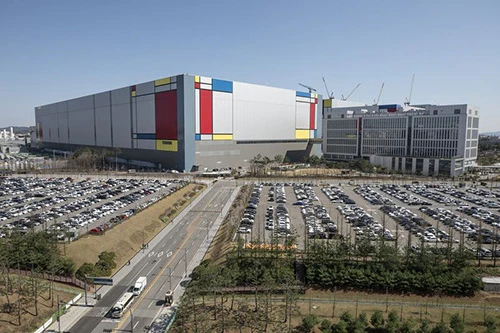
According to a report by South Korean media ZDNet KOREA, benefiting from the demand for memory chips driven by artificial intelligence (AI), Samsung Electronics has recently significantly increased the capacity utilization rate of its flagship 8th-generation (V8) NAND Flash production line located in the Pyeongtaek campus in South Korea, which has now reached 80%.
The report stated that the flagship NAND Flash production line in Samsung’s Pyeongtaek campus mainly produces V8 NAND Flash. Its capacity utilization rate remained at an average level of 60% to 70% in the second quarter of 2025. However, after entering the third quarter, the operating rate of this production line has rapidly increased to 80%, meaning the capacity utilization rate in the third quarter has risen by more than 10% compared with the previous quarter.
In addition to the end-market side—where NAND Flash prices have started to rise rapidly since the third quarter—activities in the upstream supply chain also reflect signs of strong growth in the memory industry. Among them, the order volume of materials and parts used in the manufacturing of related NAND Flash has also increased simultaneously since the middle of 2025.
In response to this, relevant sources in South Korea’s semiconductor industry pointed out that as market conditions continue to improve, the inventory of V8 NAND dropped sharply in the second half of the year, prompting Samsung Electronics to increase production again. The industry expects that the capacity utilization rate will remain at least 80% or higher in the third quarter, and this trend is also expected to continue in the fourth quarter.
V8 NAND is Samsung Electronics’ flagship NAND Flash product that has been in mass production since the end of 2022. It has a stacking layer count of up to 236 layers and currently serves as a core product line of Samsung Electronics alongside V6 NAND. The production capacity of V8 NAND is estimated to be approximately 100,000 wafers per month.
Market analysis shows that the main driver behind the rapid improvement of the overall NAND Flash market at this stage comes from the strong demand for storage devices in AI infrastructure. Currently, the growth in NAND Flash demand is mainly led by the enterprise SSD sector for servers.
At present, SSDs used in servers are mainly equipped with QLC NAND Flash. The advantage of QLC lies in its ability to store 4 bits per cell, compared with TLC which can only store 3 bits—this makes it more suitable for use in high-capacity storage devices. Although Samsung Electronics’ V8 NAND Flash is mainly composed of TLC and used in consumer applications, as the entire NAND Flash supply chain shifts toward enterprise SSDs, the inventory of consumer SSDs is also decreasing rapidly. Therefore, although Samsung Electronics’ V8 NAND Flash is only indirectly affected by this overall trend, the effect brought by the market improvement is very significant.
Analysis from market research and research institution TrendForce also shows that the average selling price (ASP) of NAND Flash is expected to rise by approximately 5% to 10% in the third and fourth quarters of 2025 respectively. The core reason for the price increase is that the production reduction strategy implemented by storage suppliers in the first half of the year has effectively reduced inventory, while the overall market demand has increased.
(Reprinted from https://news.eccn.com/)