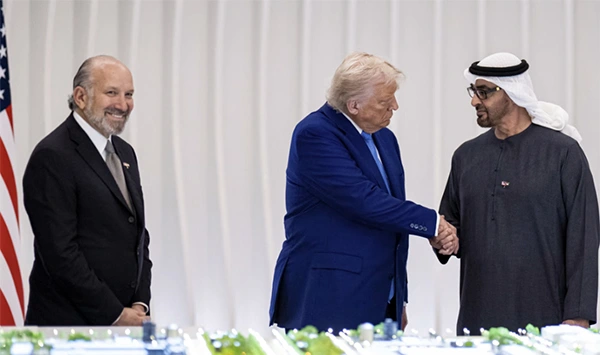
According to a Bloomberg report, the U.S. government has finally granted NVIDIA an export license, allowing the company to ship advanced artificial intelligence (AI) chips worth tens of billions of U.S. dollars to the United Arab Emirates (UAE). This move officially kicks off the large-scale bilateral technological cooperation previously agreed upon by the two parties.
It is understood that the export license obtained by NVIDIA this time corresponds to an agreement reached between NVIDIA and the UAE in May this year. The agreement permits the UAE to purchase up to 500,000 advanced NVIDIA AI chips annually (currently Blackwell, to be replaced by Rubin and Feynman in the next few years). In return, the UAE has committed to investing 1.4 trillion U.S. dollars in the United States over the next decade. It is expected that the two parties will match investments on a dollar-for-dollar basis.
The initial set of licenses obtained by NVIDIA did not cover G42, an Abu Dhabi-based AI company that is currently developing a 5 GW data center for OpenAI. However, under the terms of the agreement, G42 will be entitled to 20% of the AI chips sold to the UAE in the future.
Prior to stepping down, U.S. President Joe Biden introduced AI proliferation rules that categorized countries worldwide into three tiers, with corresponding export restrictions on AI chips. Shortly after taking office, the Trump administration revoked these restrictions.
Under the new rules, the upper limits on AI chip exports to these countries are being lifted to support new bilateral frameworks, which require allied countries to commit to using U.S.-operated cloud infrastructure.
U.S. Secretary of Commerce Howard Lutnick confirmed that only data centers managed by approved U.S. operators are eligible to run these AI systems.
This deal marks the beginning of a new era of U.S. "AI diplomacy," which links the sale of AI hardware to the UAE’s reciprocal investments and stricter control over regional AI infrastructure. In essence, it ties economic interests to strategic ones: the U.S. secures large-scale investments from the UAE and gains a foothold in the Middle East’s AI expansion, while the UAE obtains top-tier computing capabilities still under the supervision of U.S. operators.
The U.S. government views this initiative as a tool to counter China’s influence in the region. By embedding U.S. cloud providers and hardware into the UAE’s infrastructure, it aims to prevent Huawei and other Chinese companies from introducing their standards and gaining market share in the country.
However, the plan has raised questions from critics. Some officials and legislators argue that the agreement lacks precise safeguards to ensure NVIDIA’s AI chips are used only in vetted environments—especially given the UAE’s long-standing economic cooperation ties with China. Others contend that the U.S. conceded too much by increasing the annual export limit from the previously proposed 100,000 AI chips to 500,000, without securing stricter security obligations in return.
Future licenses available to NVIDIA will depend on how the UAE’s investments unfold. If this cooperation succeeds, such a partnership may serve as a prototype for similar deals between the U.S. and other allies seeking advanced AI hardware, while strengthening U.S. control over its deployment.
(Reprinted from https://news.eccn.com/)