On September 10th, the Arm UNLOCKED Summit was held in Shanghai. At the summit, Arm officially launched the Arm Lumex Compute Subsystem (CSS) for the mobile sector, which includes the all-new C1 series CPU cluster based on the Armv9.3 instruction set and the Mali G1 GPU series supporting next-generation ray tracing technology. During the post-summit media interview session, Arm executives responded indirectly to the controversy sparked by Xiaomi's launch of its self-developed Arm architecture chip, the XRING O1, earlier this year.
In May this year, after Xiaomi officially released its first 3nm flagship SoC, the XRING O1, Arm’s official website published a press release titled "XRING O1 Custom Silicon from Xiaomi is Powered by the Arm Compute Platform". Many netizens, translating the title literally, believed that Xiaomi’s XRING O1 was a custom chip developed by Arm for Xiaomi based on its CSS for Client (Arm Compute Subsystem for Clients). Although Xinzhixun (a tech media outlet) interviewed Zhu Dan, Xiaomi’s chip business leader, who refuted the rumor at the time, and Arm officially deleted the press release and republished a corrected version, various external doubts still persisted.
During the media interview after the Arm UNLOCKED Summit, Chris Bergey, Arm’s Senior Vice President and General Manager of the Client Business Unit, pointed out that self-developed chips by leading smartphone manufacturers like Xiaomi represent a major trend. This is because companies such as Apple, Samsung, and Huawei have all moved in this direction to varying degrees over the years. In fact, this is a trend facing the entire technology industry—for it is not only smartphone manufacturers that aim to develop their own chips; data center operators and automakers (especially in China, where the automotive market is huge) are also seeking customized chips.
Against this backdrop, Arm’s CSS platform was developed to align with this trend. As such, Arm took the lead in launching the Arm Neoverse CSS for servers in 2023, the Arm CSS for Client in 2024, the Zena CSS for the automotive sector in June 2025, and the newly unveiled Arm Lumex CSS.
However, the core competencies of these enterprises lie in operating data centers, manufacturing automobiles, or producing smartphones—not in CPU design. For self-developed chips, while integrating Arm’s CPUs and GPUs is important, it is not the core expertise of these companies.
Chris Bergey emphasized that this is precisely why Arm’s CSS platform holds significant value for them: “They no longer need to hire hundreds of engineers to integrate our IP. Instead, they can focus on the areas that truly create differentiation—such as autonomous driving accelerators, ISP (Image Signal Processor) and image processing pipelines for mobile phones, or accelerators for specific workloads deeply coupled with computing units in data centers.”
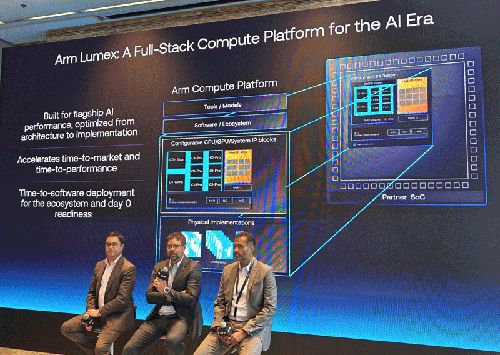
In simple terms, Arm’s CSS platform provides customers with more comprehensive CPU/GPU cluster solutions, software stacks, and physical layouts based on advanced process nodes. This helps customers significantly reduce investment in R&D for CPU/GPU clusters in self-developed chips, allowing them to focus more on R&D for their core differentiated needs, improve the success rate of chip tape-outs, and accelerate product launch cycles.
Chris Bergey explained: “They don’t need to hire hundreds of engineers to integrate our IP anymore; instead, they can concentrate on what truly brings differentiation—like autonomous driving accelerators, mobile ISP and image processing pipelines, or workload-specific accelerators tightly integrated with computing units in data centers. This is the core advantage of Arm and our CSS platform. We provide a proven computing foundation that enables customers to achieve their desired customization at a relatively low cost. The real value does not lie in creating an Arm CPU better than what Arm’s engineers have designed—in fact, even if that were achievable, the performance improvement would be at most around 5%. The true value addition comes from building their own SoC on top of the Arm platform, which allows them to create an additional 50%, 100%, or even 200% value.”
While Arm did not directly address previous external doubts such as “Xiaomi’s XRING O1 is a custom chip by Arm” or “Xiaomi’s XRING O1 is customized based on Arm CSS”, James McNiven, Arm’s Vice President of Product Management for the Client Business Unit, clearly stated during the interview that Arm’s current CSS platform only focuses on its strengths: CPU and GPU IP, as well as cluster solutions. It can provide customers with reference designs and physical implementations, but this does not mean Arm uses the Lumex CSS platform to develop complete SoC solutions for customers. Nor can customers directly send designs based on the Lumex CSS platform to wafer foundries for chip production—because an SoC cannot operate with just CPUs and GPUs; the CSS platform is not a complete SoC solution. Customers still need to integrate a series of their own IP or third-party IP (such as interface IP, ISP, NPU, baseband IP, etc.) into the Lumex CSS platform to build a complete SoC solution.
(Reprinted from https://news.eccn.com/)