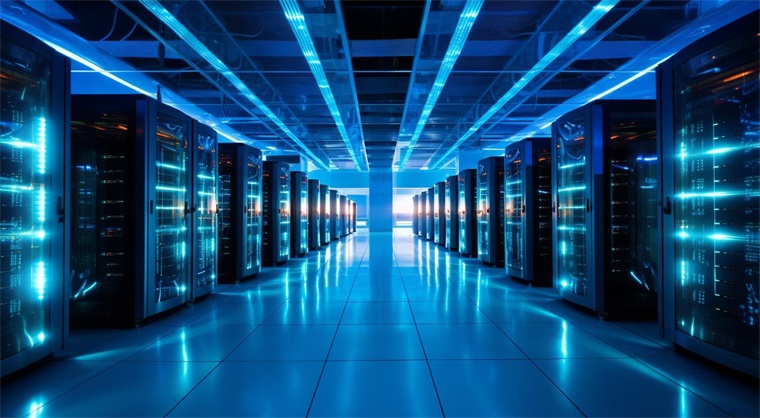
Data centers, as the core of computing power, IC hardware affects their performance and energy efficiency. Server CPUs, GPUs, and other ICs undertake data processing and tasks. High-performance computing ICs can accelerate workloads such as AI training and big data analysis in data centers. Storage ICs (such as flash ICs in solid-state drives) ensure efficient data storage and readout, enhancing data access speed. In addition, power management ICs optimize the power distribution in data centers, reduce energy consumption, and help data centers achieve green and efficient operations.
server'sCPU (Central Processing Unit) is the core of data center computing, Intel's Xeon series server CPUs, with their multi-core, high clock frequency architecture, can handle a large number of parallel computing tasks simultaneously. In cloud computing data centers, when users access cloud office software and store files simultaneously, server CPUs quickly schedule computing resources to ensure a smooth operation for each user. GPU (Graphics Processing Unit) also plays an important role in data centers, NVIDIA's Tesla series GPUs, in the scenario of artificial intelligence training, accelerate the training process of deep learning models through large-scale parallel computing. For example, training a large image recognition model, GPU clusters can shorten the training time from months to days.
In terms of storage, the flash IC in the solid-state drive (SSD) is the carrier of data storage. Samsung's 3DNAND flash memory IC, with multi-layer stacking technology, significantly increases the storage capacity within a limited chip space. In data centers, a large number of SSDs equipped with flash memory ICs are used in storage servers, providing users with high-speed data read and write services. For example, the order data and user information storage of e-commerce platforms, SSD's fast read and write capabilities ensure the response speed of users placing orders and querying information. At the same time, memory ICs (such as DDR5 memory modules) provide temporary data caching for server computing, and high-frequency, large-capacity memory ICs allow the CPU to quickly access the data needed for computing, improving data processing efficiency.
Data centers consume massive amounts of energy, and power managementICs are key to energy conservation and consumption reduction. TI's power management ICs can precisely regulate the power supply to devices such as servers and switches, dynamically adjusting the power supply voltage and current based on the device's computing load. When the load is lower at night in the data center, the power management ICs reduce the power supply, reducing energy waste. Network switch ICs ensure efficient connectivity within and outside the data center. Broadcom's Ethernet switch ICs support high-speed network data forwarding. In the network cabinet of the data center, switch ICs act as "traffic directors," allocating data traffic between servers and between servers and external networks to different network channels to avoid network congestion and ensure stable cloud computing and big data services provided by the data center to the outside world.