Recent data released by market research firm Counterpoint Research shows that global NAND Flash market revenue jumped 70% quarter‑on‑quarter in Q2 2026, marking the second consecutive quarter of historic gains following a 90% rise in Q1. This growth is almost entirely driven by sharp price increases: NAND Flash contract prices soared 55% quarter‑on‑quarter in the second quarter, while overall shipment volumes remained largely flat.
In terms of performance by major vendors, Samsung Electronics retained its top‑ranked global revenue position thanks to high average selling prices, posting a 28% market share in Q2. Though down slightly from 29% in Q1 and 32% in the same period of last year, it remains far ahead of its competitors. SK Hynix took second place with a 19% market share, up 1 percentage point quarter‑on‑quarter. Micron Technology ranked third with a 15% market share, representing a 2‑percentage‑point quarter‑on‑quarter increase.
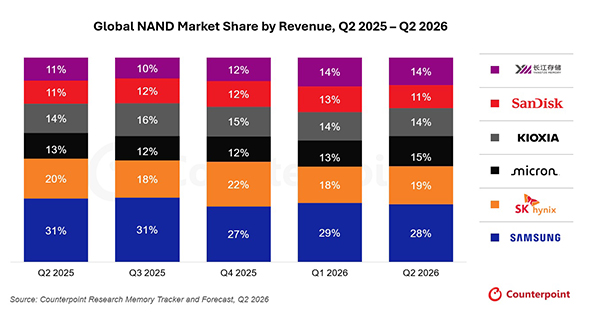
China‑based major NAND Flash manufacturer Yangtze Memory Technologies (YMTC) held a 14% market share, flat quarter‑on‑quarter and up 3 percentage points year‑on‑year. It tied for fourth place with Kioxia and held roughly a 3‑percentage‑point lead over fifth‑ranked Sandisk. Analysts note that as the top three NAND Flash suppliers shifted focus toward higher‑margin enterprise‑grade customers, YMTC actively absorbed spilled‑over market demand, which has effectively boosted its business performance and market share.
According to the latest IPO prospectus filed by YMTC’s parent company YMTC Holdings, the firm recorded revenue of RMB 63.185 billion and net profit of RMB 14.211 billion in 2025. In Q1 2026, it achieved revenue of RMB 47.042 billion and net profit of RMB 33.379 billion, with single‑quarter profit standing at approximately 2.35 times its full‑year 2025 net profit.
Looking ahead, multiple institutions and industry analysts generally expect that surging data‑storage demand fueled by the AI boom, combined with new NAND Flash capacity not set to come online gradually until 2027, will delay any meaningful easing of tight supply‑demand conditions across the NAND Flash market. More conservative outlooks suggest supply‑demand balance for the NAND Flash market may not be restored until after 2028.
(Reprinted from https://news.eccn.com/)