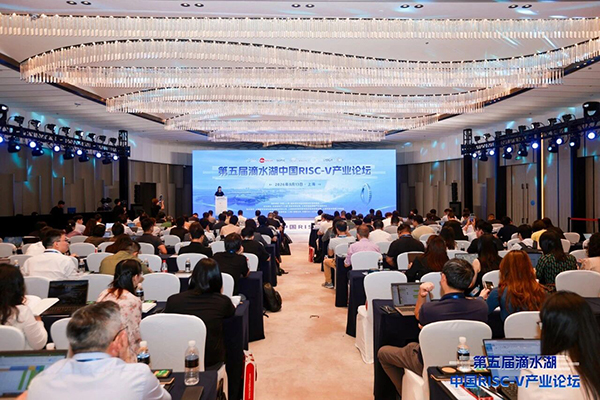
On August 13, 2026, the 5th Dishui Lake China RISC‑V Industry Forum grandly opened at InterContinental Shanghai Dishui Lake in Lingang. Co‑hosted by VeriSilicon and the Shanghai Open Processor Industry Innovation Center, the forum brought together representatives from government, industry, academia, research institutions and investment circles. Centered on “Development Opportunities for RISC‑V in Edge AI”, it showcased the latest industrialization achievements of domestic RISC‑V chips and further fostered the growth of the RISC‑V ecosystem in Shanghai.
Yu Wenjie, Deputy Director‑General of Shanghai Municipal Commission of Economy and Informatization, delivered an opening address. He noted that open instruction‑set architectures represented by RISC‑V have become a vital underpinning for intelligent computing and interconnection across all things in the AI era. Shanghai has consistently prioritized ecosystem cultivation for RISC‑V industry development. Since participating in the establishment of the international foundation in 2015, launching the China RISC‑V Industry Alliance in 2018, and setting up the Shanghai Open Processor Industry Innovation Center in 2024, Shanghai has continuously hosted the Dishui Lake Forum and RISC‑V China Summit to facilitate in‑depth engagement among domestic RISC‑V chip developers, application vendors, investment institutions and upstream‑downstream industry players. He stated that Shanghai is striving to build a globally influential RISC‑V industrial hub with three key workstreams. First, build a robust technology ecosystem. Leveraging the Shanghai Open Processor Industry Innovation Center, Shanghai will support leading enterprises to tackle core key technologies for high‑performance RISC‑V processors tailored for the AI‑agent era. Second, foster a computing‑power‑driven application ecosystem. Focusing on scenarios such as data centers, cloud computing and AI computing hubs, Shanghai will push RISC‑V beyond peripheral auxiliary roles toward core computing workloads. Third, forge an open and collaborative ecosystem by deepening cooperation with the RISC‑V International Foundation and top domestic and international institutions. Yu Wenjie also disclosed that Shanghai will host the RISC‑V Industry Development Conference organized by the Ministry of Industry and Information Technology this year. He extended a welcome to world‑class enterprises, innovative teams and high‑caliber talents worldwide to establish operations in Shanghai and jointly build the full‑stack RISC‑V ecosystem.
Yan Yijun from the Party Committee of Lingang Special Area Administration reviewed the leap‑forward growth of the integrated circuit industry in Lingang Special Area over the seven years since its official launch. The number of integrated circuit enterprises has surged from fewer than 10 to more than 300, while industrial output value has climbed from roughly RMB 300 million to over RMB 30 billion. The industrial chain covers chip design, manufacturing, equipment, materials, packaging and testing, and core components. The “Oriental Chip Harbor” is rapidly evolving into a globally‑recognized landmark for the integrated circuit industry. Since its inception, the Dishui Lake Forum has been rooted in Lingang. Across its five editions, more than 40 new domestic RISC‑V chip products have been unveiled, achieving a mass‑production rate of 90%. A host of “China‑developed chips” have expanded from the shores of Dishui Lake into broad markets including consumer electronics, automotive electronics and industrial control. The China RISC‑V Patent Alliance was founded in Lingang in 2023. Its membership has grown from the initial 9 entities to 24, with 161 patents pooled, marking fresh progress in industrial collaborative innovation and intellectual property protection. Against the backdrop of AI expanding from cloud to edge and end‑device sides, Yan Yijun remarked that Lingang Special Area will continue to capitalize on its combined strengths in institutional innovation, open platforms and industrial agglomeration. It will keep advancing core technology research, industrial‑chain collaboration, application‑scenario opening‑up and commercialization of scientific and technological outcomes, acting as a facilitator for enterprises. It will support the Dishui Lake Forum to better connect government, enterprises, academia, research bodies and investors, driving more innovations to evolve from “usable” to “reliable for adoption” and “high‑performance”.
Rong Yi, Secretary‑General of Shanghai Integrated Circuit Industry Association, pointed out in his speech that artificial intelligence has driven a new round of global integrated‑circuit growth over the past year. Shanghai’s industry maintained solid momentum, registering a 25.3% year‑on‑year growth in 2025, with the design sector rising 30.6% year‑on‑year. Shanghai ranks fourth globally and first nationwide in integrated‑circuit competitiveness. As a key strategic track nurtured in Shanghai, RISC‑V has yielded fruitful results. Eight national authorities have issued China’s first national‑level guidance document for RISC‑V development. The RISC‑V International Foundation boasts over 4,500 members, with multiple specifications for AI, computing power and security instructions released. Global giants including Google, Qualcomm and Infineon have rolled out RISC‑V initiatives, and RISC‑V market penetration has reached 25%, breaking the dual monopoly of x86 and Arm. Since setting up the RISC‑V Specialized Committee in 2018, the Shanghai Integrated Circuit Industry Association has prioritized RISC‑V‑related services. Going forward, it will continue to serve as a bridge, deepen domestic‑international collaboration, cultivate industry talents and empower enterprises in technological breakthroughs. Rong Yi also invited attendees to the inaugural China Chip Exhibition, a specialized integrated‑circuit show running from October 12 to 16 this year alongside the China International Industry Fair. Spanning 30,000 square meters, the exhibition covers the complete industrial chain of integrated‑circuit design, manufacturing, packaging, equipment, materials, components and supply chains, accompanied by a summit forum and 12 sub‑forums.
Carrying on its long‑standing tradition, the forum unveiled a new batch of representative local RISC‑V chip products, fostering deeper connections between domestic RISC‑V chip developers, application vendors, investors and upstream‑downstream industry participants. Forum participants generally agreed that with AI gaining traction on edge end‑devices, edge‑computing and data‑center markets hold promising prospects. RISC‑V is entering a critical window of opportunity to expand from embedded applications to automotive, computing‑power and high‑end AI scenarios. Backed by solid industrial foundations, an open ecosystem and advantages in international cooperation, Shanghai is poised to play an even more prominent role in global RISC‑V competition.
(Reprinted from https://news.eccn.com/)