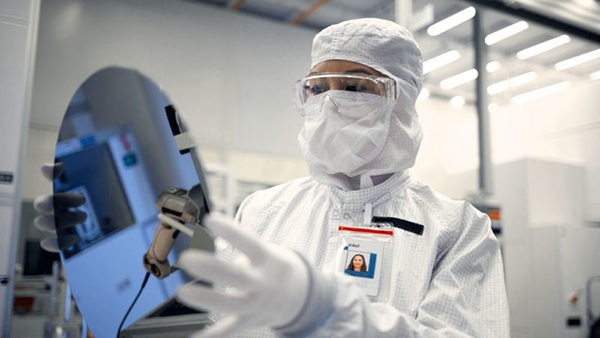
According to the latest analysis report released by market research firm BlueFin Research Partners, semiconductor giant Intel has successfully resolved previous yield bottlenecks plaguing its Intel 18A process node and delivered substantial yield improvements. This milestone advancement propels Intel’s foundry strategy into its next phase, with the more advanced Intel 18A-P node now launched for risk production.
The report shows that output at Intel’s internal fabs rose 2% quarter-on-quarter in Q2 this year, with a further modest sequential growth of 1% to 2% projected for Q3. Meanwhile, infrastructure expansion work at Intel’s Fab 42 in Arizona is advancing at full steam, with equipment installation reaching 50% completion. Once the fab enters full operation, it is expected to add an extra 7,500 wafer starts per month for the existing Intel 7 process.
Manufacturing of the high-profile Intel 18A node is predominantly concentrated at Fab 52 in Phoenix, Arizona and D1X fab in Hillsboro, Oregon. The two facilities boast a combined monthly capacity of approximately 30,000 wafers, which suffices to meet Intel’s internal product demand at present. However, capacity expansion will inevitably be required as more internal product lines migrate to this node down the line.
Back in May, Intel CEO Lip-Bu Tan commented on Intel 18A yield performance, recalling that yields for the node were unsatisfactory when he took office. “I had to bring in several ecosystem partners to review data and identify improvement paths. The industry benchmark and best practice is a 7% or 8% monthly yield uplift. Other key metrics include production throughput, defect density, and the timeline to hit targeted thresholds. Right now, we are seeing around a 7% monthly yield improvement on Intel 18A, outperforming internal forecasts, and we are on track to hit throughput and defect density targets well before the end of this year. This is a huge encouragement for me, and it is why Panther Lake is now available for volume shipments. Several clients have taken note of the tremendous strides we have made on our leading-edge nodes and started inquiring about external foundry access.”
In addition, the enhanced Intel 18A-P node has entered risk production at D1X in Oregon. This brand-new architecture delivers exceptional design flexibility: it delivers a 9% performance boost at identical power consumption, or cuts power draw by 18% while maintaining equivalent performance. Under long-term capacity plans, mass production of Intel 18A-P will shift to Fab 62 in the future.
Beyond Intel 18A, positive updates have emerged regarding the more advanced Intel 14A node, whose high-volume test results are highly encouraging and demonstrate strong feasibility for full-scale mass production. Initial manufacturing of Intel 14A will take place at Oregon’s D1X fab, followed by production at a second new fab to be built in Ohio. Per current roadmaps, risk production for Intel 14A is scheduled to kick off in 2028, with commercial mass production targeted for 2029.
To expand its external foundry footprint, Intel plans to offer cutting-edge nodes including Intel 18A-P, Intel 18A-PT and Intel 14A as commercial foundry services to outside customers. Intel CEO Lip-Bu Tan previously stated in May that the company is confident of securing formal foundry commitments from multiple partners in the second half of 2026.
(Reprinted from https://news.eccn.com/)