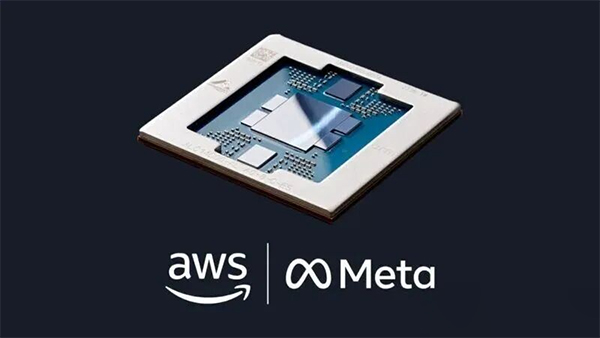
Recently, U.S. technology giant Meta has signed a cooperation agreement with Amazon Web Services (AWS) to deploy AWS Graviton processors on a large scale, supporting the construction of its new-generation AI systems. Both parties have not disclosed transaction value and other commercial details.
This collaboration reflects an ongoing shift in AI infrastructure architecture. While GPUs remain the core hardware for large-scale model training, the rising adoption of agentic AI applications has driven a substantial surge in demand for CPU-intensive workloads, including real-time inference, code generation, information search, and multi-step task orchestration.
Built on the Arm architecture, AWS Graviton processors are purpose-built for such workloads, delivering high-efficiency CPU computing capabilities tailored for Meta’s operational needs.
According to AWS, the latest Graviton5 processor is equipped with 192 Arm CPU cores, offering five times the cache capacity of its predecessor and reducing inter-core communication latency by up to 33%, enabling faster data processing and higher bandwidth. These advantages serve as critical requirements for agentic AI systems that require continuous inference and complex multi-step task execution.
Manufactured on TSMC’s 3nm (N3) process node, the Graviton5 chip is fully designed by AWS from the ground up. With end-to-end control spanning chip design to server architecture, AWS has achieved optimized performance and energy efficiency unavailable in off-the-shelf processors. The Graviton5 delivers up to 25% performance improvement compared with the previous generation.
Currently, approximately 3.6 billion people use Meta’s services worldwide. Even with 32 self-operated data centers globally to handle massive data processing, Meta still faces insufficient computing capacity. Similar to other leading technology companies such as Google and Microsoft, Meta is making substantial investments to secure additional computing power and meet surging operational demands.
Notably, in March this year, Arm broke through its traditional product portfolio and business model by expanding into mass-produced server chips, officially launching the AGI CPU — an in-house designed processor built exclusively for AI data centers, to address the fast-growing workload demands of agentic AI.
Fabricated on TSMC’s 3nm process, the AGI CPU adopts a dual-chiplet design and integrates 136 of Arm’s latest Neoverse V3 cores. Each core is equipped with 2 MB of L2 cache, running at a base frequency of 3.2 GHz and a boost frequency of 3.7 GHz. Featuring independent per-thread core design, it delivers deterministic performance under sustained workloads to avoid frequency throttling and thread idling.In terms of memory and interface support, the AGI CPU supports 12-channel DDR5 memory with speeds up to 8800 MT/s, delivering a total memory bandwidth exceeding 800 GB/s, or 6 GB/s per core, with latency lower than 100ns. It includes 96 PCIe Gen6 lanes and native CXL 3.0 support for memory expansion and pooling, with an overall TDP of approximately 300 watts.
Arm stated that servers powered by the AGI CPU can deliver more than double the performance of x86 platforms per rack. For every gigawatt of computing power in AI data centers, AGI CPU-based infrastructure can reduce capital expenditure (CAPEX) by up to $10 billion compared with traditional x86 CPU solutions.
Meta has been confirmed as one of the first launch customers for Arm AGI CPU. Together with its large-scale procurement of AWS Graviton5 processors announced in this partnership, it fully demonstrates Meta’s strong and growing demand for Arm-based server CPUs.
(Reprinted from https://news.eccn.com/)