Yesterday, the 3rd International Digital Energy Exhibition grandly opened in Shenzhen. Industry leaders, organizations, think tanks, experts, customers, and partners from around the world gathered as scheduled to jointly discuss cutting-edge industrial trends, new technology applications, and benchmark business practices, and work together to promote the high-quality development of the digital energy industry. At the opening ceremony, Zhou Jianjun, Vice President of Huawei and President of Huawei Digital Energy's Global Marketing, Sales & Services System, delivered a speech titled "Full-Scenario Grid-Forming Technology: Accelerating New Energy (Led by Wind & Solar) to Become the Main Power Source". He stated that carbon neutrality has moved from consensus to action, and the penetration rate of wind and solar energy is rising rapidly. This has led to a weaker power grid, and the power system is facing the "dual-high" challenge of high proportion of new energy and high proportion of power electronic equipment. Relying on continuous technological innovation and accumulation, Huawei has further built full-scenario grid-forming capabilities to support the construction of a stable new power system, drive new energy (led by wind and solar) to accelerate its transformation into the main power source, and usher in a new era of full-scenario grid-forming.
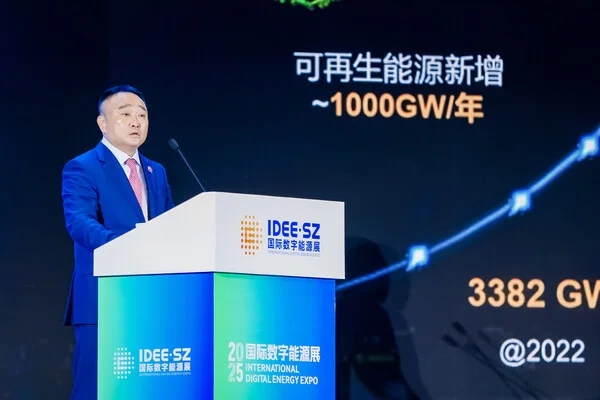
As a technology provider and enabler, Huawei has continuously invested in R&D and laid out research on grid-forming technology for more than 10 years. From following the power grid, supporting the power grid to proactively forming the grid, it has continuously led the industry's development. By integrating self-developed basic hardware (high-overload and high-reliability power devices, high-intelligence and high-computing-power digital control devices), architectures (highly available string-type architecture, high-security bipolar power architecture), and algorithms (intelligent grid-forming algorithms), Huawei has built full-scenario grid-forming capabilities with six core competencies around the "generation, transmission, distribution, and consumption" of electricity. These competencies include short-circuit support capability, virtual inertia support capability, wide-frequency oscillation suppression, fast primary frequency modulation, minute-level black start, and seamless grid-connection/off-grid switching capability, promoting the transition from "energy storage grid-forming" to "photovoltaic-storage integrated grid-forming".
Currently, grid-forming technology has been widely applied and commercially scaled globally, setting benchmarks for the world's green and low-carbon transition. On the shores of the Red Sea in the Middle East, Huawei's grid-forming technology has helped customers build the world's largest 100% new energy microgrid, which has operated stably for 2 years, withstanding short-circuit impacts caused by harsh weather multiple times to ensure stable power supply. In the 30MW PV + 6MW/24MWh energy storage project in Gaize, Ali, Tibet, Huawei assisted customers in deploying a grid-forming energy storage solution in an extremely weak power grid environment with high altitude and severe cold. This increased the grid-connected PV power generation capacity from 1.5MW to 12MW, with 75% more energy absorption than other industry solutions, significantly boosting project returns. In the Philippines, the world's largest integrated PV-storage project has kicked off the journey to bridge the power gap, including 3.5GW of PV and 4.5GWh of grid-forming energy storage. Based on Huawei's GW-level PV-storage coordinated control technology and full-station black start technology, it can achieve constant power output for 13 hours a day.
Huawei is committed to leading the industry in digital and intelligent technological innovation, building the industry's first "terminal-edge-cloud" full-link collaborative PV-storage intelligent agent. This enables intelligent lifecycle management of power stations, realizing minimal human intervention and unmanned operation and maintenance of power stations, as well as maximizing the benefits of power transactions. By deeply integrating AI into the entire process of "planning-construction-operation-maintenance", Huawei has reduced the error between project implementation and design by 40%, improved operation and maintenance efficiency by 50%, and increased operating income by more than 10%. This helps customers build safer, more efficient, and intelligent new energy power stations, leading the industry into a new phase of "autonomous operation".
High quality is the cornerstone of the industry's sustainable development. Huawei Digital Energy adheres to quality first and wins through quality. Relying on systematic and process-based capabilities and an end-to-end quality strategy, Huawei implements high-quality requirements throughout the entire lifecycle of products, from demand definition, incoming material management, production and manufacturing to delivery and services, continuously creating greater value for customers.
Looking to the future, Huawei Digital Energy will continue to work with industry authorities, power grid enterprises, industry associations, and standardization organizations to improve industry standards and power market mechanisms. It will join forces to promote the large-scale, standardized, and high-quality development of the industry, and accelerate the transformation of new energy (led by wind and solar) into the main power source.
(Reprinted from https://news.eccn.com/)