According to a Bloomberg report, the United States has revoked Taiwan Semiconductor Manufacturing Company (TSMC)’s authorization to freely ship key equipment to its major chip manufacturing base in China, which may undermine the production capacity of this older-generation factory. The report notes that U.S. officials recently notified TSMC of their decision to terminate the so-called "Validated End-User (VEU)" status of the Taiwan-based chipmaker’s Nanjing factory. This move mirrors the U.S. action to revoke the VEU status of Samsung and SK hynix’s factories in China, with the original exemption set to expire in approximately four months.
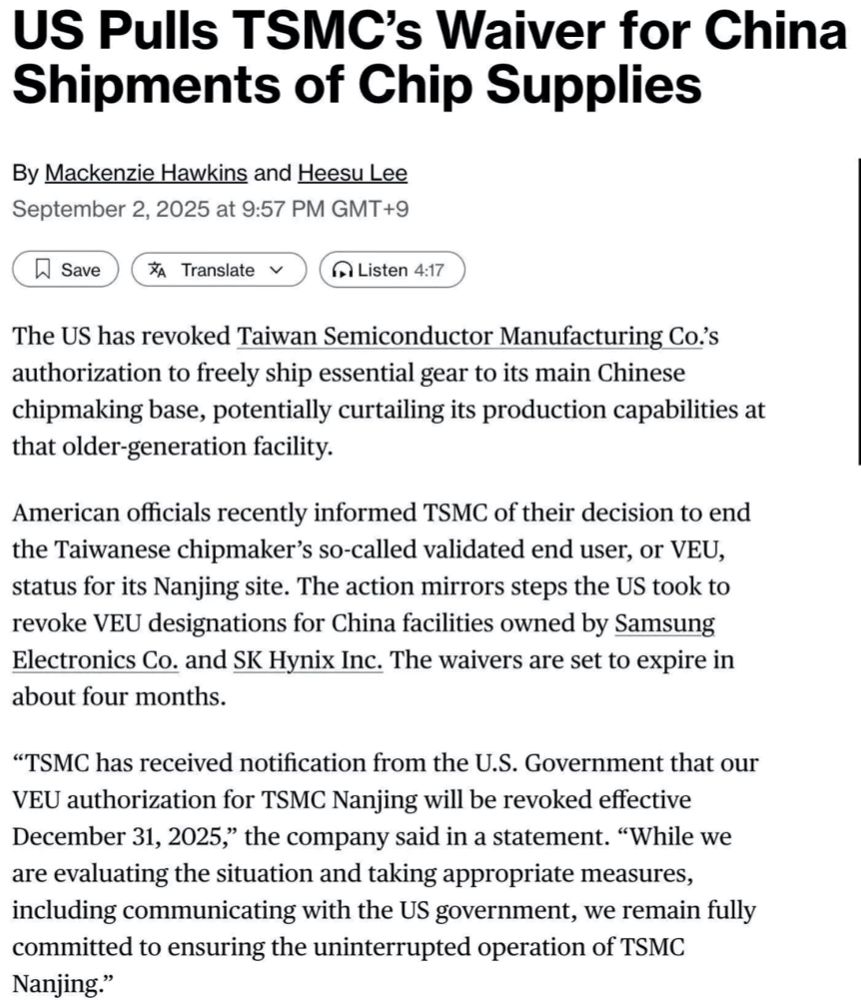
Subsequently, TSMC stated in a statement: "TSMC has received notification from the U.S. government that the VEU authorization for TSMC Nanjing Factory will be revoked starting from December 31, 2025. We are assessing the situation and taking appropriate measures, including engaging in communications with the U.S. government, while we remain fully committed to ensuring the normal operation of TSMC Nanjing Factory."
Last week, the U.S. Department of Commerce’s Bureau of Industry and Security (BIS) announced in the Federal Register (the public record of U.S. regulations) the revocation of VEU decisions for Intel Semiconductor (Dalian) Co., Ltd. (whose assets were transferred to SK Group’s Solidigm system earlier this year), Samsung China Semiconductor Co., Ltd., and SK hynix Semiconductor (China) Co., Ltd. The BIS stated that the U.S. is closing "export control loopholes" that have put U.S. companies "at a competitive disadvantage." According to the Federal Register notice, this move will require U.S. officials to process an additional 1,000 license applications annually.
Washington’s action endangers the Chinese operations of some of the most important companies in the semiconductor industry—these companies are from two major chip manufacturing giants and are also U.S. allies. Although U.S. officials have stated that they intend to issue licenses necessary to maintain the operation of these facilities, the shift from blanket permits to individual approvals has introduced uncertainty regarding the waiting time for actually obtaining these licenses. People familiar with the matter said that officials are currently exploring solutions to reduce the administrative burden, especially amid a significant backlog of existing license applications.
TSMC’s Nanjing Factory, which started production in 2018, houses advanced technologies such as 16nm. Compared with Samsung and SK hynix, which have a considerable portion of their production in China, TSMC’s manufacturing operations in China are relatively small, accounting for only a small fraction of its total revenue last year. Since TSMC’s VEU status was never published in the Federal Register, there are no public regulations for the BIS to modify, unlike for other affected companies. However, when the VEU revocation takes effect, suppliers to the chipmakers’ Chinese factories will need to proactively seek U.S. licenses to ship goods subject to U.S. export controls—this includes everything from advanced manufacturing equipment to spare parts and chemicals consumed in the production process. Overall, the net impact on TSMC, Samsung, and SK hynix will be the same.
This situation highlights the extent of U.S. influence and control over the electronic component supply chain. The U.S. has imposed broad restrictions on China’s access to U.S. materials and equipment that can be used to manufacture advanced chips, as part of a series of regulatory measures aimed at limiting China’s artificial intelligence capabilities.
During the Biden administration, three companies—Samsung, SK hynix, and TSMC—were granted indefinite exemptions, allowing them to continue shipping to their factories in China as long as they complied with security requirements and disclosed certain information to the U.S. government. Given that semiconductor factories require regular imports of materials to maintain operations, this authorization was crucial for both chipmakers and foreign government officials. The Trump administration’s current announcement to revoke the exemption order will inevitably have a negative impact on the relevant industrial chain.
(Reprinted from https://www.eepw.com.cn/)