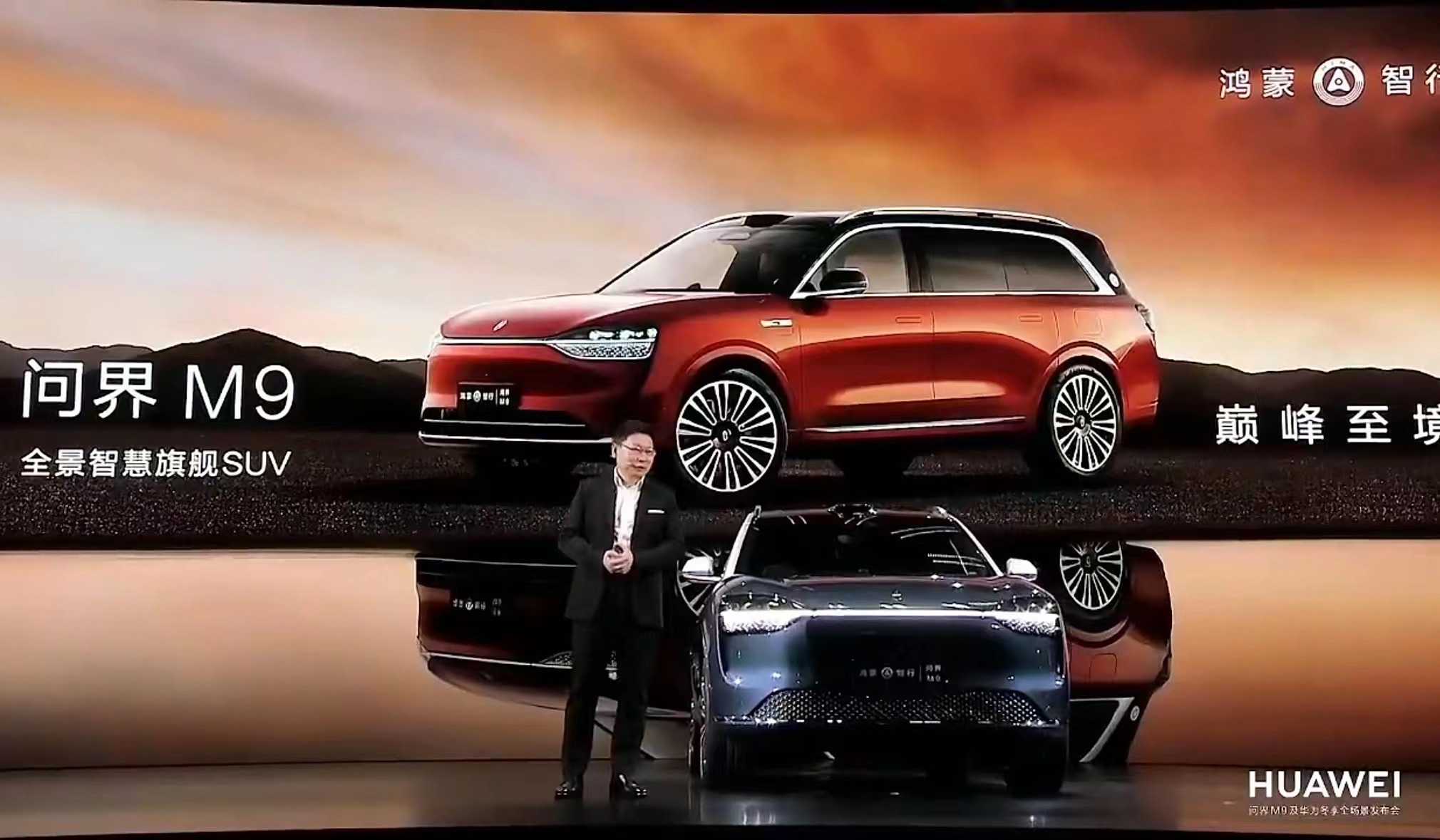
Kang Bo, Vice President of Seres, announced at the Paris Motor Show that the AITO brand will officially enter the European market in the autumn of next year. Alongside this overseas expansion plan comes industry-shaking news: on October 20, 36kr reported that AITO’s overseas models will abandon Huawei’s intelligent driving solution and instead jointly develop a system with Bosch under the "BOSCH Inside" cooperation model. Bosch has kicked off development work for AITO’s overseas vehicles, with high-speed NOA currently scheduled for mass production in September next year.
This means AITO, whose core selling point in the Chinese market is Huawei Qiankun ADS, will switch its intelligent driving stack to Bosch for its first overseas market. For a brand deeply empowered by Huawei technologies, this adjustment reflects practical considerations over overseas regulations, data compliance and localized supply chains.
AITO is a premium smart vehicle brand co-designed and co-developed by Seres and Huawei, officially defined as "Adding Intelligence to Auto". Seres was Huawei Terminal’s first automotive partner. The two parties launched the "Smart Selection Vehicle" collaboration in April 2021, and rolled out the AITO brand and its first model by the end of the same year. In 2024, Seres acquired the trademarks and appearance patents for the AITO series, consolidating brand assets under Seres.
The cooperation model saw new changes in 2026. Starting September 15, 2026, within the Harmony Intelligent Mobility ecosystem, AITO adopted a new framework: "Seres leads product definition, design, marketing, channel retail and service systems, while Huawei Terminal provides technological empowerment". On September 30, the two signed a new five-year agreement and formed a dedicated team for the AITO business. AITO remains a member of Harmony Intelligent Mobility, yet front-end operational leadership has shifted back to Seres, with Huawei focusing more on technology enablement and ecosystem support.
In terms of market performance, AITO deliveries rose from 387,000 units in 2024 to 426,000 units in 2025, while the average transaction price climbed from RMB 377,000 to RMB 391,000. In the first half of 2026, cumulative sales of the AITO series reached 160,779 units, representing a year-on-year increase of 5.6%.
Its product portfolio covers M5/M6/M7/M8/M9. The M5 targets the entry-level established market; the M6, launched in 2026, is a high-volume five-seat SUV priced between RMB 250,000 and RMB 300,000. The M7 focuses on the RMB 300,000 family segment, while the M8 and M9 move upward to the RMB 400,000–600,000 bracket. The all-new M9 hit the market on May 27, 2026, debuting ADS 5 and six-liDAR hardware.
AITO’s intelligent driving is not a single fixed configuration, but a combination of "Huawei Qiankun ADS software architecture + diverse sensor hardware + phased OTA rollout", with notable differences across model years and variants.
Qiankun ADS 4, unveiled in 2025, features capabilities including the WEWA World Engine / World Behavior Model, CAS 4.0 full-dimensional collision avoidance, P2P 2.0 valet parking from parking spot to parking spot, and Valet Parking Drive (VPD). Huawei stated it supports scenarios such as highway toll station ETC and multi-story underground parking garages. At launch, it was divided into SE/Pro/Max/Ultra tiers by hardware and functions, with Ultra built for high-speed L3 capabilities. Huawei released ADS 5 at the Qiankun Technology Conference on April 23, 2026. Powered by WEWA 2.0, its cloud-based world model incorporates multi-agent game theory with 10-fold enhanced training intensity. The vehicle-side system adopts the safety risk field theory, which Huawei claims can cut collision risks by 50%. Safety assessment has expanded from five dimensions to a six-dimensional full-time domain. As of August 2026, total assisted driving mileage of Qiankun intelligent driving has exceeded 14.5 billion kilometers.
According to public reports on OTA rollout schedules, ADS V5.0 started pushing updates in July 2026. Subsequent batches of features including active-passive fusion, false steering prevention and Driver Incapacity Assist 2.0 will launch between September–October 2026 and January–February 2027. Huawei also noted that upgrading ADS 4 Max/Pro/SE to corresponding ADS 5 versions carries no hardware restrictions, though actual compatibility still depends on vehicle sensors and redundancy configurations.
On the hardware front, high-end trims of the new M9 and M8 feature the most robust hardware package. The new M9 intelligent driving hardware includes one 896-line dual-optical-path image-grade LiDAR, one co-optical-path in-cabin LiDAR, and four high-precision solid-state LiDARs, often summarized by media as the "six LiDAR" setup. The M8 spec sheet lists the premium version of Huawei Qiankun ADS 5; its high-end variant uses an 896-line primary LiDAR plus three solid-state LiDARs. Entry and older models such as the AITO new M5 Ultra adopt the ADS 4 + 192-line LiDAR solution. Clear generational and price-tier differentiation exists within AITO’s lineup. The system supports active safety functions including highway / urban NCA, parking-to-parking navigation, valet parking / remote parking, AEB, LOCP, rear collision prevention and eAES.
The shift away from Huawei intelligent driving toward Bosch’s "BOSCH Inside" model for overseas models marks a critical divergence in AITO’s intelligent driving roadmap for global expansion. Per 36kr’s report, Bosch has commenced development for AITO overseas vehicles, with high-speed NOA mass production tentatively scheduled for September next year — largely aligning with Kang Bo’s announcement at the Paris Motor Show of entering Europe in autumn next year. Choosing Bosch enables AITO to leverage Bosch’s European engineering system, regulatory compliance expertise and local supply chain, while circumventing potential geopolitical hurdles that Huawei’s intelligent driving solution may face in overseas markets.
Notably, reports also state that besides AITO, Luxeed, co-developed by Huawei and Chery Group, is actively preparing for overseas launch, and preliminarily plans to deploy Chery’s self-developed solutions including Falcon intelligent driving and Lingxi intelligent cockpit. The two Harmony Intelligent Mobility members are not directly adopting Huawei’s intelligent driving stack for overseas expansion. This demonstrates that Chinese smart vehicle brands are flexibly adjusting their technical roadmaps according to target-market regulations and supply chain conditions amid globalization.
(Reprinted from https://news.eccn.com/)