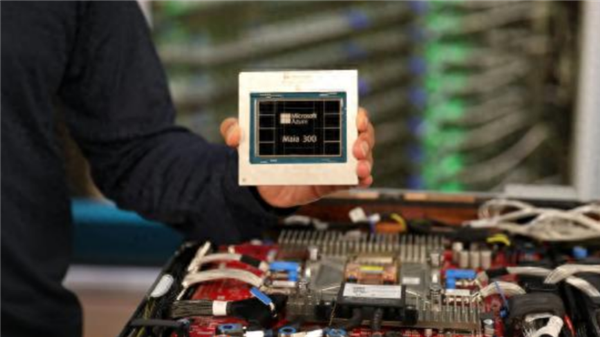
Microsoft has launched its latest artificial intelligence (AI) chip, the Azure Maia 300, aiming to cut reliance on third‑party chip vendors including NVIDIA and AMD. Together with the existing Maia 200 and Maia 100, the Maia 300 completes Microsoft’s AI chip product portfolio.
Scheduled for real‑world deployment in 2027, the Maia 300 will see scaled‑up adoption starting next year. Microsoft plans to roll out gigawatt‑scale deployments of the Maia family, positioning the lineup as the primary AI inference system for its products and services.
Each Maia 300 rack will house 96 chips, double the chip count of the prior‑generation Maia 200 rack. According to the company, a rack populated with 96 Maia 300 chips can deliver up to seven times the token throughput of a Maia 200 rack.
Microsoft also stated that for AI inference workloads, the Maia 300 delivers 40% higher token processing per megawatt of power compared to leading GPU systems.
In terms of hardware design, the Maia 300 adopts a multi‑chiplet architecture. Its core compute tile is manufactured on TSMC’s advanced 2‑nanometer process and equipped with HBM4 high‑bandwidth memory to boost AI inference efficiency.
NVIDIA GPUs have long served as the standard for AI workloads and model execution. They are widely deployed across Microsoft’s existing data centers and power model training for AI labs such as OpenAI and Anthropic.
Driven by surging demand for AI computing, a growing number of technology firms are adopting diversified chip solutions from players including Amazon, AMD, Cerebras and Google.
Microsoft is accelerating deployment of its in‑house chips to reduce dependence on external suppliers. The company debuted its first AI chip, the Maia 100, in 2023, followed by the second‑generation Maia 200 last January.
In a client report released last Wednesday, analysts at Evercore ISI projected that Maia chips will account for roughly 10% of Microsoft’s AI‑chip spending by Q1 2027.
Beyond Microsoft, other hyperscale cloud operators such as Amazon, Google and Meta, alongside organizations including OpenAI and Anthropic, have either released or are developing custom silicon.
These entities pursue in‑house chip development to lower reliance on external vendors like NVIDIA and AMD, while tailoring chip designs to the unique requirements of their AI businesses.
Nevertheless, Microsoft’s push for broader in‑house chip deployment does not signal a full‑scale move away from NVIDIA and AMD. The Maia family is optimized primarily for AI inference, while Microsoft will maintain partnerships with NVIDIA and AMD for AI model training.
Customers continue to demand a diverse mix of chips to cater to varied workload requirements. As a result, hyperscalers such as Amazon and Microsoft will keep purchasing the market’s most sought‑after processors, which for the foreseeable future remain supplied by NVIDIA.
(Reprinted from https://news.eccn.com/)