Recently, AI memory chip developer Lingkai Semiconductor closed its financing round for Q2 2026, co-led by Oriental Fortune Capital and DT Capital Partners. The deal underscores strong recognition from capital markets toward Lingkai Semiconductor’s core technologies, innovative development roadmap and strategic value within its niche sector.
As large AI models transition from training-centric deployment into an era dominated by AI inference workloads, they have emerged as a vital new engine driving economic growth. Nevertheless, the prevailing HBM memory architecture is persistently plagued by two critical pain points: excessive costs and high power consumption. It struggles to accommodate the industry trend of AI inference spreading toward lightweight, edge and end-device scenarios, evolving into a major bottleneck holding back large-scale adoption of AI inference.
The self-developed next-generation HBF+ memory architecture from Lingkai Semiconductor represents a disruptive breakthrough tailored for the era of large-scale AI inference models, unlocking an untapped market niche featuring high capacity, high bandwidth and ultra-low power consumption.
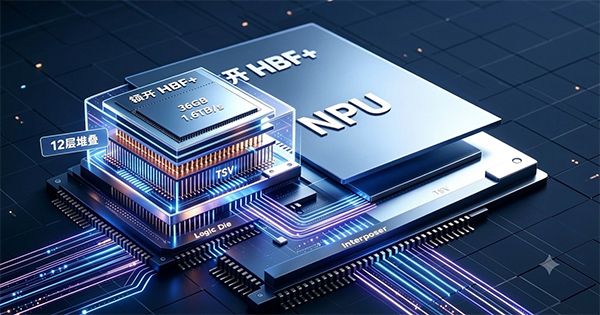
Authoritative industry projections estimate the global AI inference memory market will surge toward USD 3000 billion by 2030, presenting massive upside and promising long-term growth prospects. Compared with conventional HBM solutions, HBF+ products deliver equivalent high bandwidth and high capacity while cutting static power consumption to just one-thousandth of that of HBM. This clears the path for inference deployments, especially end-side applications such as embodied robots. Most critically, HBF+ achieves full 100% compatibility with mature HBM architecture as well as upstream and downstream ecosystem interfaces. It requires no brand-new adaptation development, enabling rapid mass production and large-scale commercialization based on existing established industry standards. With its unique strengths of compatible upgrading and efficient substitution, the technology builds solid competitive moats in both technology and product dimensions.
Such robust technical barriers stem from the company’s long-standing R&D expertise and innovation accumulation. Lingkai Semiconductor has pioneered its proprietary ATopFlash© technology, which fully embodies the core essence of the Tatsu Law, tapping the ultimate performance potential of memory chips. It delivers comprehensive optimization across four dimensions: performance, power consumption, cost and reliability, yielding an optimal memory solution customized for AI inference scenarios.
Lingkai Semiconductor holds the view that HBM will remain the mainstream general architecture for large AI model training, whereas HBF+ technology is poised to become the dedicated architecture designed specifically for large-scale AI inference models.
(Reprinted from https://news.eccn.com/)