CAS Space announced today that its self-developed 110-ton Liqing-2 pintle-type liquid oxygen/kerosene engine has recently passed a new round of long-duration qualification firing tests.
During this test campaign, the single engine accumulated a total firing duration of 620 seconds, meeting the requirement of 3.5 times the nominal in-flight operating time. Its longest single continuous burn reached 400 seconds, setting a new record for the maximum steady single-shot runtime of this engine model. To date, the total accumulated reliability test runtime of the Liqing-2 engine has exceeded 2,000 seconds.
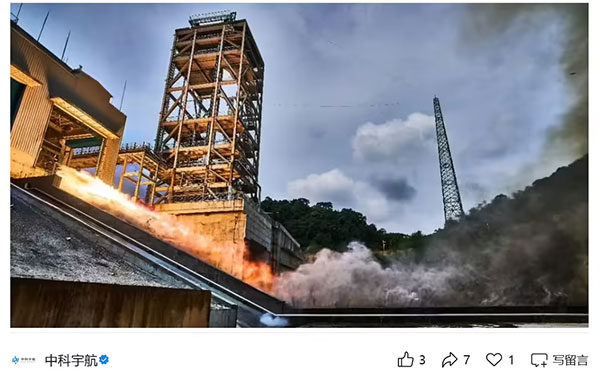
According to CAS Space, this firing served as a rigorous qualification-level extreme assessment, with total operating time equivalent to 3.5 times the engine’s actual working duration during rocket flight. Throughout the entire test, engine parameters remained stable, combustion stayed steady with low vibration levels, and all measured metrics complied with design specifications. Post-test inspection confirmed sound physical condition of the unit. This firing thoroughly validated the performance of core critical technologies including the pintle injector, thrust chamber composite cooling structure and turbopump, further laying a solid foundation for the engine’s reusability capability.
The Liqing-2 is a 110-ton liquid oxygen/kerosene engine independently developed by CAS Space featuring a pintle injector design, making it China’s highest-thrust pintle-type engine to date. Adopting liquid oxygen and kerosene propellant with a gas generator cycle, the engine supports thrust throttling between 50% and 100% as well as multiple restart capability, achieving a combustion efficiency of up to 95.8%. Technically, primary seals on all engine valves employ metal sealing technology. Integrated design of regulating valves and on-off valves enables adaptive thrust adjustment, effectively reducing part count and overall engine weight. Its specific impulse stands no less than 275 seconds with a thrust-to-weight ratio exceeding 150 seconds. Completion of this 620-second long-duration qualification test signifies that CAS Space has fully mastered three core technologies: pintle injector design, lightweight high-efficiency turbopump development, and multi-restart engineering.
The single steady firing duration of Liqing-2 has been continuously elevated from 120 seconds to 200 seconds and further to 400 seconds. Development of the engine kicked off in Q2 2023. The first unit was delivered in February 2025; a half-system test was successfully conducted in August 2025; a 110-ton long-duration firing was accomplished in December 2025; a 200-second long-duration test was completed on March 12, 2026, pushing total accumulated test time past 1,000 seconds.
CAS Space Liquid Propulsion System Test Center is situated in Conghua District, Guangzhou, covering a land area of 1,016 mu. Its core infrastructure includes test stands for 200-ton and 30-ton liquid oxygen/kerosene engines, plus a 400-ton liquid oxygen/kerosene propulsion system test facility.
As a cornerstone product of CAS Space’s liquid propulsion lineup, Liqing-2 will serve as the main engine for the reusable Kinetica-2 launch vehicle and the heavy-lift Kinetica-2 Heavy variant. The maiden flight of the inaugural Kinetica-2 rocket was successfully completed on March 30, 2026. Going forward, the Kinetica-2 family will be retrofitted with reusable Liqing-2 engines. The Kinetica-2 Heavy configuration will add two side boosters to its first stage. Both launch vehicles adopt a clustered recovery scheme based on common core stage strapping design. CAS Space plans to construct a reusable liquid engine industrial base in Huangpu District, Guangzhou, with a designed annual production capacity of 300 Liqing-series engines.
The engine has now entered formal reliability qualification, poised to deliver more powerful, cost-effective and diversified propulsion options for the Kinetica rocket family. CAS Space stated that it will keep iterating commercial aerospace propulsion products characterized by high reliability, high operational efficiency and controllable costs, deepen technological innovation in reusable propulsion systems, and leverage its self-controllable core propulsion portfolio to underpin major national initiatives including large-scale low-orbit satellite constellation deployment and low-cost space cargo transportation missions.
(Reprinted from https://news.eccn.com/)