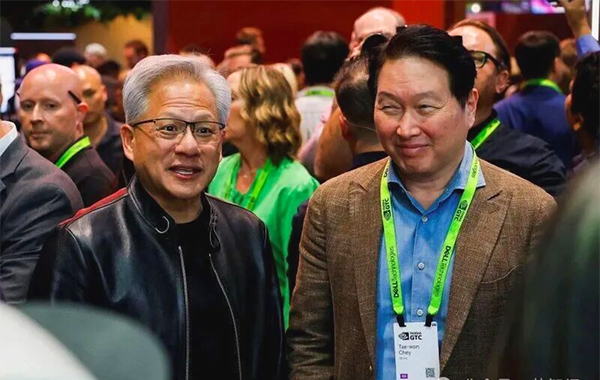
According to Reuters and other foreign media, Chey Tae-won, Chairman of SK Group, the parent company of South Korean memory chip giant SK Hynix, predicted in a media interview at NVIDIA GTC 2026 that the global DRAM chip shortage may continue until 2030, as DRAM supply can hardly keep pace with demand growth.
Chey pointed out that artificial intelligence (AI) requires GPUs, which in turn demand large volumes of high-bandwidth memory (HBM), and the production of HBM relies heavily on DRAM wafers. As a result, the DRAM industry will need at least "four to five years" to expand wafer capacity.
He added, "The situation is the same no matter where we go. Even if we build capacity outside South Korea, it will take the same amount of time." Therefore, he expects the current shortage to persist until 2030, with a shortfall of more than 20% for basic DRAM wafers.
Asked whether SK Hynix plans to expand capacity at overseas manufacturing sites to meet rising demand, Chey said the company is currently focusing on expanding production through new wafer fabs in South Korea, as adequate power and water supplies, as well as a supporting ecosystem, remain major obstacles to overseas expansion.
"The issue right now is not capital or government subsidies, but energy and water resources, and whether a suitable ecosystem exists locally," Chey stated.
Due to the limited pace of DRAM capacity expansion, SK Hynix will first focus on stabilizing DRAM chip prices. Chey also revealed that SK Hynix is preparing measures to stabilize prices but declined to elaborate, only saying, "I cannot announce it here, but our CEO will unveil a new plan on how to stabilize DRAM prices."
Nevertheless, Chey acknowledged that SK Hynix cannot focus excessively on HBM while letting the general DRAM shortage worsen. "If we concentrate too much on HBM, mainstream DRAM will become even scarcer, which will in turn impact existing industries such as smartphones and laptops."
Both Samsung and Micron have recently announced the launch of their HBM4 products. Market observers expect the two companies have secured large orders from NVIDIA, which could threaten SK Hynix’s dominant position in the HBM market.
Asked whether SK Hynix’s leadership in the HBM market would be weakened amid future price pressures and competition, Chey said, "We will do our best."
Chey also disclosed that he plans to meet and negotiate with tech giants including NVIDIA CEO Jensen Huang. "NVIDIA is one of our key customers. I expect the meeting to take place, and I also plan to meet with other companies," he said. He also referred to TSMC as a "very good partner" and noted, "Without TSMC, it would be nearly impossible to develop solutions such as Vera Rubin."
Regarding the development of China’s domestic memory industry, Chey commented, "I understand the China market is also facing memory supply shortages. It is impressive that they can still sell products outside China under such circumstances. Depending on the policies of Chinese enterprises, new competition may have emerged."
On the possibility of listing American Depositary Receipts (ADRs) in the United States, Chey believes such a move would help expand SK Hynix’s shareholder base beyond South Korea, increase access to U.S. and international investors, and strengthen its global influence.
As for the impact of escalating conflicts in the Middle East that have driven up global energy prices, he responded that the situation has created significant difficulties, and surging energy prices have forced SK Group to secure sufficient alternative energy sources to maintain operations.
(Reprinted from https://news.eccn.com/)