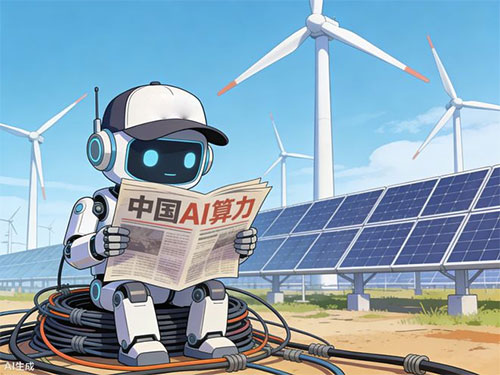
According to a report by foreign media outlet Business Insider, Elon Musk, CEO of Tesla and SpaceX, stated in the podcast Exploring the Moon with Peter Diamandis released on Tuesday (local time in the U.S.) that China will far outpace all other countries in terms of computing power required for running artificial intelligence (AI).
“China will have greater (AI) computing power than any other country, and will very likely possess more chips,” Musk pointed out. “Based on current trends, China will pull well ahead of the rest of the world in the field of AI computing.”
Musk believes that China’s decisive advantage in the AI race lies in its ability to scale up electricity generation. He projected that by 2026, China’s power output could reach approximately three times that of the United States, enabling the country to support energy-intensive AI data centers.
As the performance of AI chips continues to improve, their energy consumption has also risen significantly, making power supply a critical limiting factor for scaling up AI systems. “People underestimate how difficult it is to integrate electricity into the grid,” Musk added.
Despite the United States’ ongoing focus on restricting China’s access to advanced semiconductor technologies, Musk said that over time, these restrictions may become less significant. He believes that China will ultimately “resolve the chip issue.”
With current semiconductor manufacturing processes advancing to the 2nm node, transistor miniaturization has become increasingly challenging and costly, while the resulting improvements in performance and reductions in power consumption have diminished. Moore’s Law is thus on the verge of obsolescence. Musk also opined that this trend of “diminishing returns” may make it easier for China to catch up, even if it cannot obtain the most advanced chips.
Musk’s remarks come at a time when tech giants around the world are scrambling to build AI data centers, many of which consume as much electricity as small cities. This has made energy supply the primary constraint on AI scaling, rather than chips or algorithms.
A report released by Goldman Sachs in November noted that power shortages could slow the U.S.’s progress in the AI race. “Given the massive electricity requirements of AI, a reliable and abundant power supply will be a key determinant of the outcome of this race, especially since bottlenecks in power infrastructure may take a long time to resolve,” the report added. It pointed out that while pressure on the U.S. power grid is mounting, China has been steadily expanding its power supply capacity.
Goldman Sachs projected that by 2030, China will have approximately 400 gigawatts of spare power capacity, more than three times the total global power demand of data centers. “We expect China’s spare power capacity to be sufficient to meet the growth in data center power demand while supporting the needs of other industries,” wrote Goldman Sachs analysts.
At the Future of AI Summit held in the UK in early November last year, Jensen Huang, founder and CEO of NVIDIA, also publicly stated that China will beat the U.S. in the AI race, thanks to its lower energy costs and more relaxed regulations.
In late December 2025, Michael Burry—best known as the inspiration for the protagonist in The Big Short for his successful bet against the subprime mortgage bubble prior to the 2008 financial crisis—also issued a warning that the U.S. may gradually fall behind China in the AI race due to its over-reliance on NVIDIA’s highly energy-intensive AI chips.
On the social media platform X, Michael Burry argued that the high-energy-consumption AI chip roadmap promoted by NVIDIA may not be the optimal path for advancing AI development; on the contrary, it could cause the U.S. to lose the AI race to China. His core argument hinges on the structural gap in power infrastructure between China and the U.S. He pointed out that China’s power generation capacity is roughly twice that of the U.S., and the expansion speed of its energy infrastructure is significantly faster. He emphasized that this is not only a difference in total power scale, but also a gap in expansion speed, which will put the U.S. at a structural disadvantage in terms of long-term capital investment.
(Reprinted from https://news.eccn.com/)