In a recent media interview, Yang Gong Yifan, Founder and CEO of Zhonghao Xinying, revealed that the company’s second-generation 7nm TPU chips have been returned from fabrication and entered the testing phase, with official shipment scheduled for the second quarter of 2026. The supporting software stack is under concurrent development, with continuous expansion to support new PyTorch 2.x operators and MoE parallel computing strategies.
Yang stated that going forward, the company will basically adhere to a product iteration cycle of "one new chip per year and two software stack updates per year", to continuously enhance technological competitiveness and market responsiveness. Meanwhile, Zhonghao Xinying has established a framework cooperation with Tianpu Co., Ltd., leveraging respective strengths to jointly expand the AI track.
According to online leaks, Zhonghao Xinying’s second-generation TPU chips are mainly targeted at autonomous driving model training and data center inference scenarios. The single-chip computing power is expected to reach 400–800 TFLOPS, with performance goals set to surpass mainstream products such as Google TPU v5p and NVIDIA H100. In terms of energy efficiency, it may reduce power consumption by over 30% compared with GPUs, while further optimizing the cost per unit computing power. It is speculated that the company may leverage the customer channels of the acquired Tianpu Co., Ltd. to provide high-performance computing support for automakers, integrating TPU technology into intelligent cockpit domain controllers and ADAS advanced driver assistance systems. However, the above information has not been officially confirmed.
Public data shows that Zhonghao Xinying was founded in 2019. Its core founding and R&D teams consist of experienced AI hardware and software design experts from global tech giants including Google, Oracle, Facebook, Microsoft, Samsung, and HiSilicon. Founder Yang Gong Yifan once participated in the core architecture development of Google TPU v2, v3, and v4. The company’s main products include high-performance AI chips and computing clusters supporting large-scale AI model training, providing a complete integrated hardware-software solution. It delivers AI innovation technologies capable of driving production transformation for global customers, accelerating the engineering implementation and industrialization of artificial intelligence.
TPUs adopt a systolic array architecture, which implements matrix multiplication/accumulation operations as hardwired pipelines. Computations are completed during data transmission within the array, eliminating the repeated read-write steps to shared cache or video memory required by traditional GPUs. Field test data of Google’s 6th-generation Trillium and 7th-generation Ironwood TPUs shows that under the same 7nm process, the AI computing power per watt of TPUs is 1.4–2.0 times that of GPUs. Compared with the first-generation TPU launched in 2018, the energy efficiency has been improved by nearly 30 times.
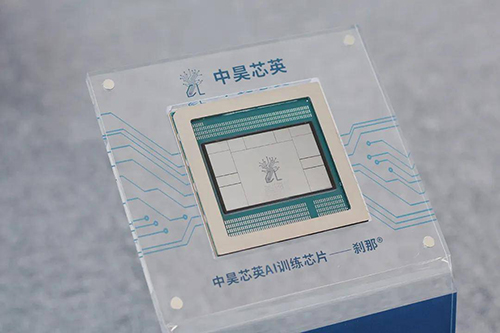
In 2023, Zhonghao Xinying successfully mass-produced and delivered China’s first high-performance TPU training chip "Chana", an independently developed product designed specifically for AI training. Based on a 12nm process, Chana features a fully independent and controllable IP core, self-developed instruction set, and computing platform. Its peak computing performance reaches 1.5 times that of the NVIDIA A100, with 30% lower power consumption under similar large-model workloads, and the cost per unit computing power is approximately 42% of that of comparable foreign chips, demonstrating distinct advantages in performance, energy consumption, and cost.
Based on the Chana chip, Zhonghao Xinying has built the "Taize" AI server and the "Taize" large-scale AI computing cluster system, which realizes efficient interconnection of 1,024 chips and supports the training and inference of ultra-large models with over 100 billion parameters. The total computing power of the cluster exceeds 200 PFLOPS, meeting the training requirements of trillion-parameter models. Benefiting from its ultra-high AI computing performance and ultra-low energy consumption, the company secured a procurement order worth over RMB 900 million from the Qinghai "Silk Cloud Valley" Low-Carbon Computing Industrial Park by the end of 2023. It has also made progress in multiple sectors including energy, education, and manufacturing, achieving profitability.
In 2024, the company’s 1,000-chip Taize computing cluster was put into operation in the Yangtze River Delta and Beijing-Tianjin-Hebei regions, with field tests proving its capability to stably train 100-billion-parameter models. In 2025, the Tianjin Mobile TPU Intelligent Computing Center was officially launched, marking the domestic TPU’s realization of the three-step leap from "single chip → full cabinet → intelligent computing center" and the commencement of commercial computing power services. Official data indicates that under the same precision, its inference cost is 40–60% lower than that of GPUs.
In September this year, Zhonghao Xinying launched a mandatory tender offer for Tianpu Co., Ltd., with an offer price of RMB 23.98 per share, planning to acquire 25% of the listed company’s shares. Eventually, Yang Gong Yifan, Founder of Zhonghao Xinying, will become the new actual controller of the listed company through Zhonghao Xinying and Hainan Xinfan.
According to the announcement disclosed by Tianpu Co., Ltd., Zhonghao Xinying achieved an operating income of RMB 598 million and a net profit of RMB 88.91 million in 2024; however, in the first half of 2025, its revenue dropped to only RMB 102 million with a net loss of RMB 143 million.
(Reprinted from https://news.eccn.com/)