While TSMC’s first 4nm fab in Arizona, U.S., has already entered mass production, its under-construction 3nm facility is not expected to start volume production until 2027. Overall, both processes will lag two generations behind TSMC’s most advanced technologies deployed at its Taiwan (China) fabs.
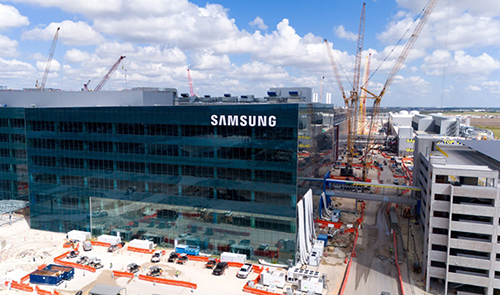
Taking advantage of this gap, TSMC’s competitor Samsung Electronics is planning to be the first to mass-produce its cutting-edge 2nm process at its Taylor fab in Texas, U.S. Beyond strengthening its existing foundry partnership with Tesla, Samsung aims to attract major U.S. tech giants including AMD and Google.
According to a report by South Korean media ebn.co.kr, Samsung Electronics Chairman Lee Jae-yong recently met with executives from several large U.S. tech companies, including Tesla CEO Elon Musk and AMD CEO Lisa Su, to discuss collaboration in the foundry business.
The report stated that during this visit, Lee discussed cooperation on next-generation AI chips, stable semiconductor supply, and the utilization of U.S.-based production infrastructure with Musk. Back in July this year, Samsung Electronics signed a KRW 23 trillion foundry supply contract with Tesla, under which Samsung will manufacture Tesla’s next-gen AI chip AI6 at its Taylor fab.
Recently, there have been rumors that Samsung is collaborating with AMD to conduct sample testing of its second-generation 2nm (SF2P) process. In addition, executives from Google’s Tensor Processing Unit (TPU) division have visited Samsung’s Taylor fab to negotiate capacity supply issues.
A semiconductor industry insider revealed, "From what I know, Google’s TPU team visited Samsung’s Taylor fab to discuss production capacity and the volume they can secure."
TPUs are AI chips custom-designed by Google for its data centers. As TPUs emerge as competitors to Nvidia’s data center AI chips, their supply volume is expected to surge significantly. Google is now planning to sell TPUs—previously only for internal use—to external companies such as Meta.
Geopolitical risks and the limited production capacity of TSMC’s U.S. fabs are believed to be the key reasons why major tech firms like Tesla, AMD, and Google are engaging with Samsung Electronics.
According to reports from Taiwanese media, Lin Fa-cheng, Deputy Minister of Taiwan’s National Science and Technology Council, stated, "The government reviews the 'List of Key Strategic Technologies' annually and strictly enforces the 'N-2 Principle' to prevent technology leakage." The N-2 Principle mandates that technologies introduced to overseas factories must be at least two generations behind the most advanced processes available in Taiwan (China).
Deputy Minister Lin added, "We impose strict controls on R&D personnel in critical technology fields. The economic authority also restricts the export of products and technologies based on this list. The majority of TSMC’s R&D staff remain in Taiwan (China) and comply with government regulations."
Therefore, once the scale of TSMC’s process technologies deployed in the U.S. exceeds a certain threshold, they will be subject to rigorous scrutiny. This review will also assess the impact of investments on the industry and the adequacy of technology protection measures from a regional security perspective.
Under TSMC’s plan, its second fab in Arizona is scheduled to start 3nm mass production in 2027. However, considering that TSMC’s latest 2nm process is on the verge of mass production at its Taiwan (China) fabs, and is expected to be upgraded to 1.6nm (A16 process) by 2027, TSMC’s most advanced 3nm process in the U.S. at that time will lag two generations behind its home-based technologies.
In contrast, Samsung Electronics is projected to start mass-producing its 2nm process at the Taylor fab as early as next year. According to Sedaily, the Taylor fab was 93.6% completed by the end of Q3, with full completion slated for July 2026 and mass production expected to kick off by the end of 2026.
This represents a significant opportunity for Samsung Electronics, as the Taylor fab will become the only foreign-owned facility in the U.S. capable of mass-producing cutting-edge 2nm chips. Additionally, compared to TSMC’s limited supply capacity in the U.S., the surging customer demand is bringing another window of opportunity for Samsung’s foundry business.
In Q3 this year, TSMC held a 71% share of the global foundry market. Bolstered by nearly 100% of AI semiconductor orders, its market share jumped from 61.2% in Q4 2023 to over 70% in Q3 this year. Despite TSMC’s continuous customer acquisition and growing market share, its capacity shortage is creating openings for Samsung Electronics’ foundry operations.
Apple is already facing a capacity crunch for next-generation 2nm chips, having secured nearly half of TSMC’s total 2nm production capacity. Meanwhile, Nvidia—another major TSMC client—reportedly plans to start 2nm chip production in 2027. As a result, competitors including Qualcomm, AMD, and Google are turning their attention to Samsung Electronics’ advanced process capacity in the U.S.
(Reprinted from https://news.eccn.com/)